This issue of Pythoness Perspective was sent to newsletter subscribers. Browse all issues
Pythoness Perspective
Alt Text Is a Workflow — Not a Perfectionism Trap
- From
- Amanda Nelson · Pythoness Programmer
- Reply-To
- help@pythonessprogrammer.com
- Sent
- Authors
- Amanda Nelson
Why alt text matters for accessibility, SEO, and AEO — plus a copy-paste template, Sunday batch habit, Bluesky's require-alt-text setting, and platform quirks.

You post a flyer. The date and price live inside the graphic. The caption says "new offer!" The alt field says image1234 — or nothing at all.
Someone on a slow connection sees a broken image icon. Someone using a screen reader hears "image" and nothing else. Someone watching muted in a waiting room cannot select the text baked into your JPEG. The message did not land. The format left them out.
Images are content, not decoration. When they disappear — slow connection, screen reader, sensory overload, or a brain that processes text better than visuals — the information should still be there. Neuroinclusive design calls this offering information in more than one format so different brains can enter. Alt text is how you make that true without rebuilding your entire visual brand.
The goal is a workflow, not a perfectionism spiral. Fifteen minutes today. A Sunday batch if you post often. Describe what matters, skip what does not.
If you have been following this month's accessible-design habits, you already know readable contrast and scannable structure change how your work feels — for strangers and for future you. This week we turn to the images themselves.
Pope Leo XIV's recent encyclical Magnifica Humanitas charges that AI must be "disarmed, welcoming and accessible." Alt text is accessible in the most literal, hands-on sense: care for the human on the other end of the screen. Leo calls prudence about technology "responsible care for the human family." Describing your images honestly is a small act in that tradition — human care for other humans, not a checkbox.

~3 min read
This week: Why alt text matters for accessibility, SEO, and AEO — plus a copy-paste template, Sunday batch habit, and platform quirks.
Do this today (15 minutes): Fix alt text on your top three images — hero, product shot, or last three posts with text-in-image. Use the template below.
Resource: Neuroinclusive Design — practical examples for brain-friendly, barrier-free content.
🔥 Charge forward with: Batch once, benefit all week — five images on Sunday beats a guilt backlog and a heroic all-nighter.

Part 1: If Images Disappeared, Would the Message Still Land?
The check: If images disappeared, would key information still be there?
Ask whether someone would still understand what you were offering, teaching, or selling — regardless of whether a compliance audit would pass.
Text baked into images (quotes, pricing, event dates) is the most common failure. The graphic looks great. The caption says "new offer!" without repeating the price. The alt field says image1234 or stays empty. The visual channel failed. The caption failed. Assistive tech had nothing to read.
Visual clutter drains everyone. Busy hero sections, autoplaying sliders, and six-font collages exhaust anyone scanning on a phone — not only neurodivergent readers. Alt text will not fix clutter; it pairs with clear structure and honest editing. This week we focus on describing what you keep.
Part 2: Why Alt Text Matters — For Humans, Search, and the Bots in Between
Most people hear "alt text" and think screen readers. That alone would be reason enough. Screen readers and other assistive tech read alt text aloud or convert it to braille. If your flyer's date, price, or CTA lives only inside a JPEG, you have excluded anyone who cannot see the image — full stop.
The same description also helps the systems that increasingly shape whether your work is found at all.
Search engines cannot "see" images the way humans do. They rely on alt text, filenames, and surrounding context. Descriptive alt text helps image search and page relevance — especially for product photos, portfolio work, and blog heroes. Skip the keyword stuffing. Write for clarity.
AI agents are the newer lane — crawlers, summarizers, shopping assistants, and the tools that answer questions about your business without sending traffic to your site. AEO (Agent Engine Optimization) means making your content legible to those agents. They read structured text — headings, alt text, descriptive links — to infer what a page means. Vague or empty alt fields are the visual equivalent of a wall of text: the agent guesses, or skips you.
Leo XIV writes that technology is never neutral — it takes on the characteristics of those who devise, finance, and use it. Communication works the same way. An image without description is a choice about who counts as your audience.
Clear headings plus descriptive alt text compound. Search engines and agents use both to build a model of your page. Accessible structure and accessible images reinforce each other.
How to write good alt text (rules of thumb)
Describe what matters for this context — not every pixel. "Woman in blue sweater" is thin; "Workshop facilitator demonstrating contrast check on laptop — June Accessible Tech session" is useful.
Include text that appears in the image — quotes, dates, prices, event titles. If it is critical, repeat it in the caption too (many platforms strip or hide alt).
Skip "image of" / "photo of" — assistive tech already announces it is an image.
Decorative images: use empty alt (
alt="") so screen readers skip them. Not every visual needs a novel.Functional images (icons, buttons): say what they do — "Search," "Download checklist PDF," not "magnifying glass."
Keep it under ~125 characters when you can — some platforms truncate; put the critical noun first.
Part 3: Your Alt Text Workflow — Template, Action, Platforms
| If you… | Pick one surface this week | What to change |
|---|---|---|
| Run a business | Hero image, product photo, PDF cover, email header | Alt text: what is in the image + why it matters for the page |
| Post a lot online | Next five posts with text-in-image, carousel, meme-with-message | Repeat critical text in caption or alt field; do not rely on the graphic alone |
Alt text template (copy this)
[What is in the image] — [why it matters on this page/post]
Examples
Bad:
logo_final_v3.pngGood:
Pythoness Programmer logo — links to homepageBad:
promoGood:
Workshop flyer: Accessible Tech Design, June 2026 — registration link in caption
Your 15-minute action: Fix alt text on your top three images by traffic or importance. Set a recurring Sunday batch (15 minutes, five images) if you post often — same energy as a weekly inbox reset, but for visuals.
Do it on the platform you already use:
| Platform | Where alt text lives | Quirk to know |
|---|---|---|
| Website / Squarespace / WordPress | Image block → alt / description | Decorative images: empty alt is correct |
| Shopify / product catalog | Product media alt | Include color/variant if it affects purchase |
| Mailchimp / ConvertKit | Image block alt | Repeat sale terms in body text too |
| Alt text in advanced settings when posting | Critical text must also be in caption | |
| Bluesky | Alt text field on upload; Settings → Accessibility | Turn on Require alt text before posting — see personal note below |
| PDF export | Often missed — add captions in source doc | Screen readers read PDF structure unevenly |
A personal favorite: Bluesky's "require alt text" setting
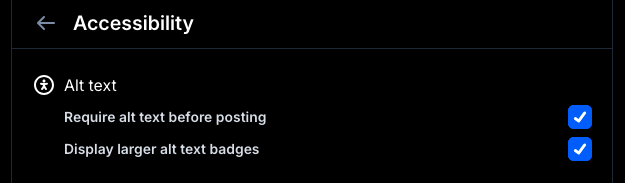
One of my favorite features on Bluesky lives in Settings → Accessibility. Turn on Require alt text before posting, and the app will not let you publish an image until you have written something in the alt field. No heroic willpower required — the platform holds the line for you.
I also keep Display larger alt text badges on, so I can see at a glance which posts in my feed actually have descriptions.
|
This matters beyond screen readers. On Bluesky, many news outlets, reporters, and activists simply will not repost content that ships without alt text. Your graphic might be brilliant. If the description field is empty, your reach stops at your own followers — not because the algorithm punished you, because thoughtful people refuse to amplify inaccessible posts.
If you post on Bluesky even occasionally, flip the setting on this week. Write one sentence per image. Watch how fast it becomes habit when skip is not an option.
Part 4: A Harder Truth — "Ethical AI" and Who Gets to Define It
Magnifica Humanitas landed in a complicated room. Jill Lepore reports that Anthropic co-founder Chris Olah appeared on the dais beside Leo at the release — unprecedented, and freighted with symbolism. Leo urges the public to push back against executives who resist restrictions. Olah's presence reminded me how easily "safety-oriented" and "ethical" get marketed while the underlying systems stay unchanged.
Leo writes that a more moral AI is not enough if that morality is determined by a few. I agree. We do not have "ethical AI" in any finished sense — not from Anthropic, not from anyone. We have products, incentives, and pattern matchers.
Karen Hao's Empire of AI sharpened that for me:
"In fact, deep learning models are inherently prone to having discriminatory impacts because they pick up and amplify even the tiniest imbalances present in huge volumes of training data. It's not just a problem when a demographic is poorly represented, but when it's overrepresented as well."
"No matter their scale, neural networks are still statistical pattern matchers. And those patterns are still at times faulty or irrelevant, now just more intricate and more inscrutable than ever."
"Even the term hallucinations is subtly misleading. It suggests that the bad behavior is an aberration, a bug, when it's a feature of the probabilistic pattern-matching mechanics of neural networks."
So where does that leave you, writing alt text on a Sunday batch? In the gap between systems you cannot fix alone and surfaces you can. Alt text disarms nothing at Big Tech scale. On your own pages and posts, it makes meaning available to humans and to the automated intermediaries between you and your audience. That is the accessible, welcoming lane at human scale.
Part 5: Someone on the Other End — Text in the Image Only
A follower sees your Story: beautiful typography, hard-to-read contrast, a caption with no structure, date and link only inside the graphic. They are watching muted in a waiting room. They cannot hear you. They cannot select the text in the image.
They tap away. The format left them out.
Batch alt text and caption discipline are how you host people who are not experiencing your content in the ideal conditions you had when you designed it.
Reflection prompt: Which recurring image type do you post most (quote card, flyer, product flat-lay)? That type gets the template first.

Your tech struggles, reflected back.
This week's prompt:
Do you batch any content task weekly (email, scheduling, invoicing)? Would you try a 15-minute "alt text Sunday" — yes, no, or what would make it realistic?
Hit reply. I read every one.

🔥 The Fire Horse's Callout: What to Charge Forward With
A Sunday batch turns alt text from a guilt backlog into a rhythm. Five images a week is sixty across a quarter — without a heroic all-nighter.
🔥 Charge forward with: The three images you will describe before you post anything else new.

WHAT'S NEXT
Next Friday, June 26: Captions and transcripts for video and audio. Honest link text and forms that do not trap. A full recap of this month's accessible-design habits — plus a printable checklist you can pin above your desk.
See you next week.
— Amanda

Subscribe to the newsletter → pythonessprogrammer.com/newsletter/subscribe
Browse free resources → pythonessprogrammer.com/resources
Shop → stickyspells.etsy.com
Support → pythonessprogrammer.com/support
Share this issue with someone who posts text-in-image without captions
Philosophize your tech use.
Part of the Accessible Tech Design series — pythonessprogrammer.com/accessible-tech-design
Resource hub: Neuroinclusive Design
This issue was sent to newsletter subscribers. Sign up to receive the next one (weekly, march–november).
Pythoness Perspective
Weekly issues, March through November only. Each month is one arc—a deep dive through a tech sovereignty resource I teach, with practical steps each week tied to the same frameworks in my free guides.